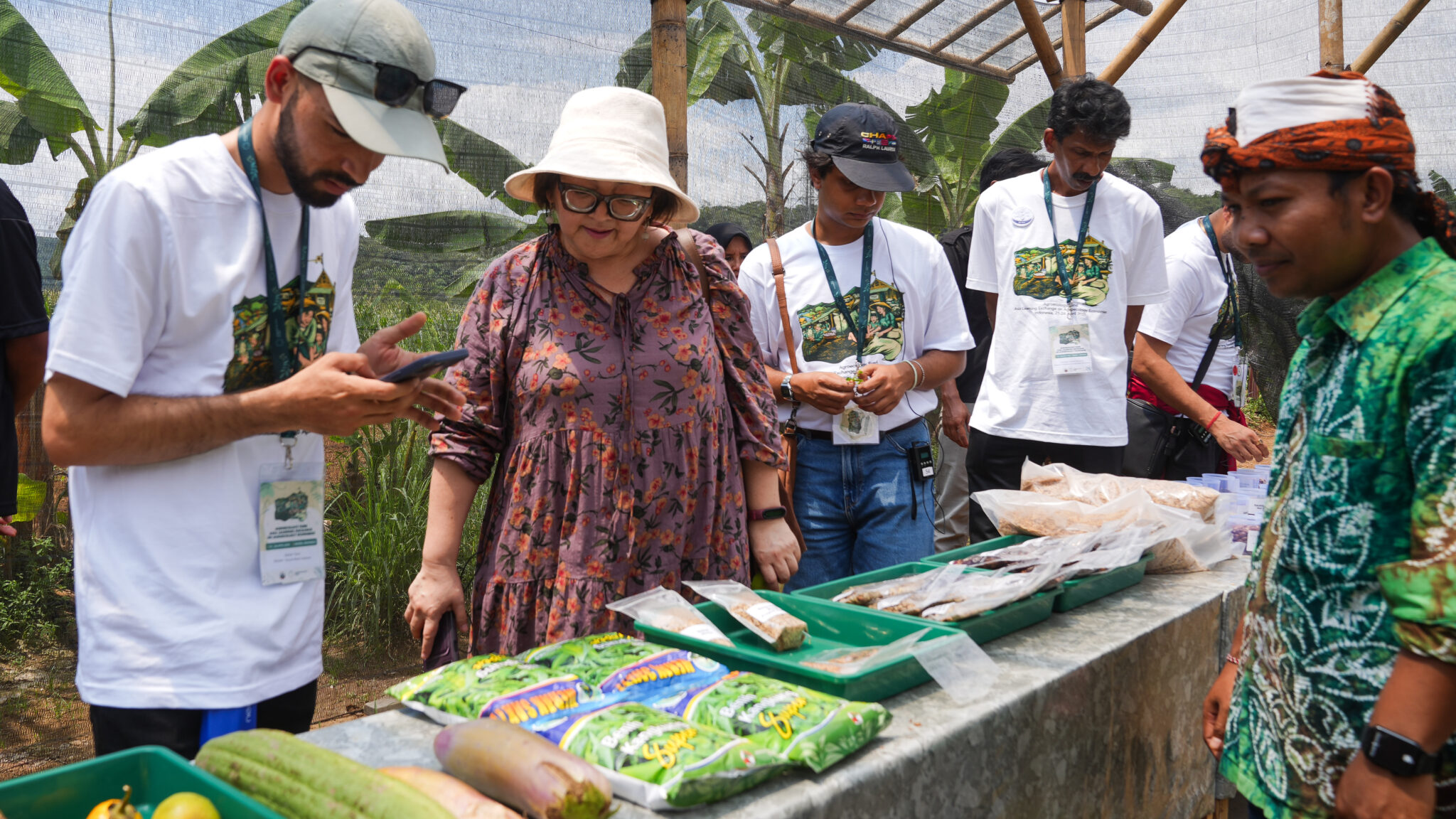
Unlike the green revolution, agroecology doesn’t spread through commercial transfer of proprietary technologies. Rather, it’s built on co-creation of knowledge and a commitment to experimentation and action research with smallholder farmers at the center of the work. A field trip to a farmer-led training school was a glimpse into not only what farmers teach one another, but how they motivate one another to innovate.
At the Asian Learning Exchange on Agroecology Economies hosted by the Agroecology Fund, we spent four immersive days (April 21 -24) in discovery and cross-learning with over 100 agroecology movement peers from across 25 Asian countries. But a conference room is one thing; getting fingers dirty in the soil is another. We made a field trip to the SPI (Serikat Petani Indonesia) Center for Agroecology Research and Implementation, which is built around a stunningly wide variety of crops in carefully-managed demonstration plots.

SPI is a farmers’ union. It formed in 1998, building on the long struggle of Indonesian peasants for rights and agrarian reform. Today, SPI is at the forefront of the fight for farmers’ land and water rights, revival of climate resilient agricultural practices, freedom to develop, conserve, use, and distribute their seeds, and sell their produce directly to their consumers. The SPI training center in Bogor trains smallholder farmers as well as peer trainers to multiply learning in villages. Curriculum covers farming to marketing strategies. SPI training schools are a step towards mainstreaming an agroecology economy in Indonesia.
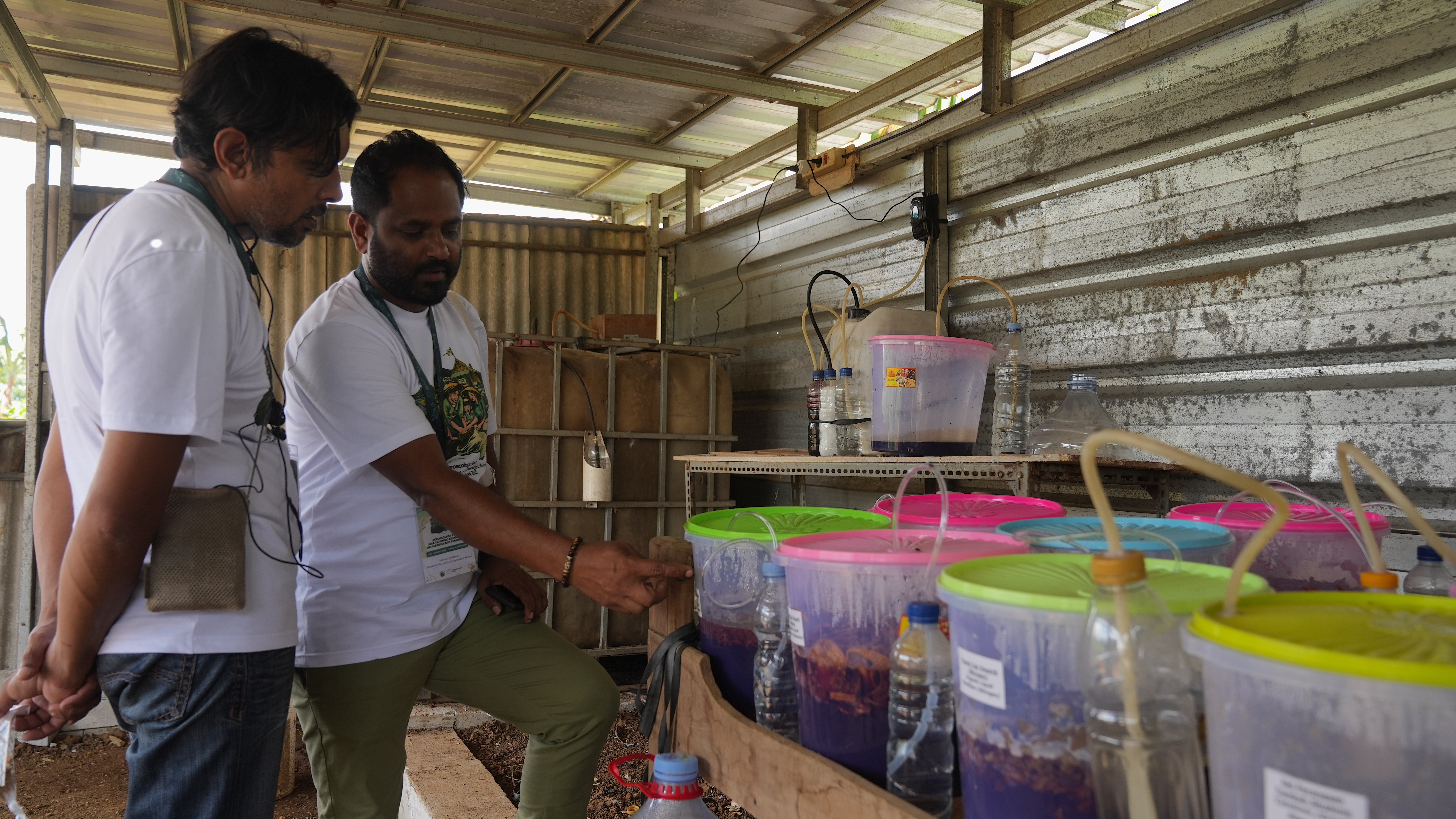
Located in peri-rural Bogor, the SPI training center is a breath of fresh air — simple and green, exuding health and abundance, airy. The center is constructed with bamboo that not only suits the region’s tropical climate but also reflects the founders’ and users’ commitment to sustainability and application of traditional knowledge. Back home, Suresh Kanna and Bakia Lakshmi of CREATE Trust, India, conserve native rice varieties in Tamil Nadu, India. At the Bogor center, they observed the integrated farming system—featuring crop diversity, intercropping, local and seasonal foods, greens, and herbs, seed displays, seed conservation efforts, and a bio-input production unit. They were inspired by “the center’s thoughtful design to provide practical training to farmers and agroecology practitioners.” With SPI, they exchanged their traditional Indian paddy seed varieties for Indonesian varieties.
Karan Singh, founder of Swaraj Farmversity in Udaipur, India, left the Bogor Training Centre impressed by the agroecological innovations, particularly the spaces created for young farmers to experiment, learn, and lead. He is keen to adapt their model of cooperatives to his context.
The integrated training program at the center covers the necessary ingredients for a robust agroecology economy, including know-how about making bio-compost, biofertilizers, biopesticides, and biofumigants using natural materials.
How has SPI sought to revive and establish agroecology in Indonesia? M Qomarum Najmi, Head of the Training Center, explained, “After the Green Revolution, our traditional farming practices almost disappeared. We rallied people’s support with our national anthem that beseeches our land to: ‘… be alive… … be fertile… … and… be holy… … for the well-being of our people’. This invocation to our land inspired us to revive traditional practices with support from our Indigenous people, who still followed traditional methods when the Green Revolution was mainstreamed.” Qomarum added, “We now document all our farm information. This information will become our knowledge, and, in time, our knowledge will become our wisdom and part of our training. That is how SPI follows knowledge management of its farming practices.”
SPI’s peasant training program is an integral part of SPI’s efforts to build a national agroecological peasant movement. According to Qomarum Najmi, “To become a member of SPI agroecological cooperatives, individuals must first complete their training in agroecological practices at the center.” During the training, farmers learn about soil preparation, making their own natural fertilizer, seed selection and seed preparation, pest management, inter-cropping, and post-harvest farm-to-market process. Qomarum said that approximately 5% of Indonesian farmers identify themselves as agroecological farmers. In addition, many peasants practice agroecology without necessarily using the term as such.
What is farming like in Indonesia? Qomarum said that over 90% of peasants in Indonesia have small landholdings of under 1 ha. Regarding farm labor, women lead the preparation and sowing of seeds. Men prepare the land, take care of irrigation, prepare biofertilizer, biopesticides, and set up natural pest control mechanisms.
After crops are harvested, they are locally cleaned, processed, packed, and marketed by village SPI cooperatives, cutting out intermediaries as feasible. The emphasis of the entire process is on empowering farmers towards obtaining a fair price for their produce, while promoting ecologically sound farming practices and food sovereignty. SPI cooperatives sell their farm produce through local markets, farmers’ markets, and community-supported agriculture initiatives, strengthening linkages to consumers in nearby urban centers.
Participants in the Learning Exchange appreciated the SPI Center’s integrated approach to agroecology from farming to marketing, with the peasants at the center. Kuluipa Akmatova from the Rural Development Fund, Kyrgyz Republic, appreciated the educational process and formation of collectives, commenting that “these approaches could serve as models for farmer and youth education back home, where we lack structured agroecology training programs.”